 Get the app
Between the AngelsSample

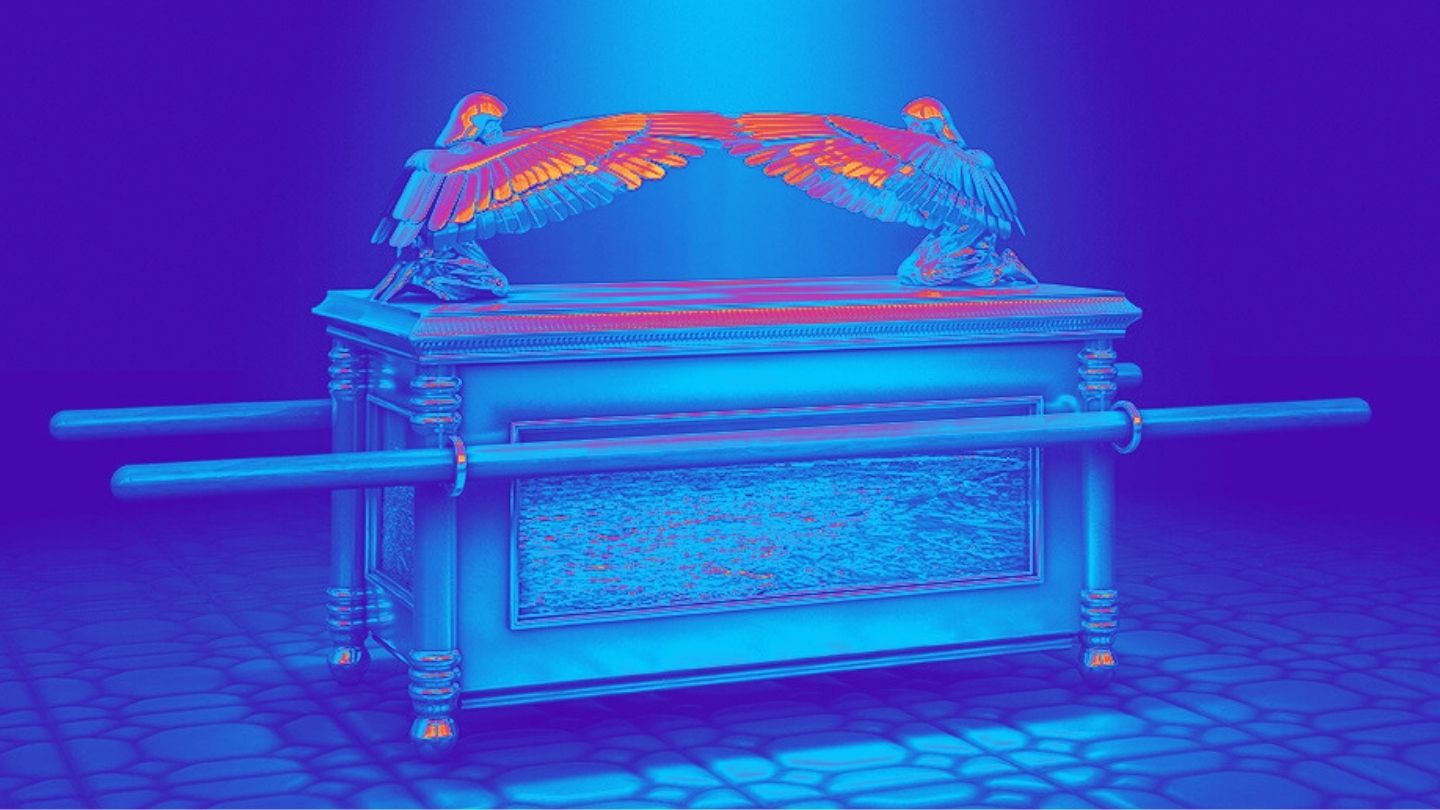
Day 2: The Shadow of the Mercy Seat
“You shall make a mercy seat of pure gold. Two cubits and a half shall be its length, and a cubit and a half its breadth. And you shall make two cherubim of gold; of hammered work shall you make them, on the two ends of the mercy seat. Make one cherub on the one end, and one cherub on the other end. Of one piece with the mercy seat shall you make the cherubim on its two ends” Exodus 25:17-19 (ESV)
In the Tabernacle of the Old Testament, the center of Israel’s worship, there was a room where no one could enter. Inside it rested the Ark of the Covenant, a gold-plated chest containing the tabernacle’s most sacred articles. On top of it was a cover, called propitiatory or the mercy seat, the kappōret in Hebrew, a solid-gold lid with two cherubim at its ends, facing each other, with their wings outstretched, covering the space between them. God told Moses that the kappōret was the place where He would meet with His people.
Once a year, and only once, the high priest was permitted to enter. He carried the blood of a sacrifice. Each movement was prescribed. Blood was placed on the mercy seat of the Ark of the Covenant to cover the sins of the people. But the covering never lasted. The following year, the priest had to return. Year after year. The pattern never broke because the solution was never definitive.
Going back to John 20. John doesn't mention the Ark when he describes the tomb where Mary arrived. He doesn't explain the angels or why he recorded their position. He simply tells us what Mary saw: two figures in white, one seated at the head, the other at the feet. And the space between them empty.
For those who knew the Law of Moses, the image would draw curiosity. Two celestial beings and a space designated for blood.
But something was different. There was no mercy seat, no blood, no priest. And there was no body.
The mercy seat always pointed beyond itself. It was never the final destination. It reserved the place for something greater, something that wouldn't require repetition year after year.
And at that moment, in the quiet of the garden tomb, something cosmic had happened. Jesus had just been the sacrifice on the cross. His dead body and His blood had been brought to the tomb. But when Mary looked inside, the tomb no longer contained the body because Jesus, also our High Priest, had risen from the dead. How magnificent!
So, the angels sitting there were not waiting for a priest to enter, as they had waited in the Tabernacle. They were sitting there because the work of covering was complete.
Hallelujah!
Note what the model of access and communion established by God implies:
- Atonement - the act of dealing with and removing the guilt of sin through a sacrifice, opening the way for the restoration of the relationship with God.
- Propitiation - the act of fully satisfying divine justice, so that righteous wrath against sin is resolved.
- Reconciliation - the restoration of friendship or communion between God and the person.
The tabernacle of Moses and all its components were shadows of what was to come. A shadow proves that something real is projecting it. The mercy seat of the Ark of the Covenant was a shadow. The shadow stretched across generations, showing the outline of what God intended. It revealed the form of atonement, the posture of encounter, and the hope of a covering that would not need to be repeated - a definitive covering for sin.
But a shadow cannot embrace you. A shadow cannot pronounce your name.
So then, on the cross and in the tomb, in the fullness of time, the substance arrived. The object that cast the shadow was revealed. What the mercy seat foreshadowed for centuries, the empty space between those angels declared fulfilled. The meeting place was no longer hidden behind a curtain. The covering was no longer temporary. Atonement, remission, forgiveness, covering, and reconciliation were no longer waiting.
The shadow gave way to the One who cast it. And He was no longer a ritual. He was a Person. Resurrected, alive, and calling Mary by name.
For Reflection:
- The patterns of the Old Testament were shadows of something greater. How does understanding the mercy seat deepen your appreciation of what Christ accomplished?
About this Plan
Two angels, one at the head and one at the feet, and the space between them empty. When Mary Magdalene arrived at the tomb, she witnessed a scene that would resonate deeply for anyone formed by Israel's Scriptures. The mercy seat of the Ark was framed by two cherubim positioned the same way, marking the place where God promised to meet His people. Coincidence, or a story unfolding across centuries? This 5-day plan follows the thread from tabernacle to tomb, where sacred imagery becomes intimate reality, and the risen Christ still speaks, calling His people each by name.
More
We would like to thank i2 Ministries for providing this plan. For more information, please visit: https://thewadi.org/videos/english/


